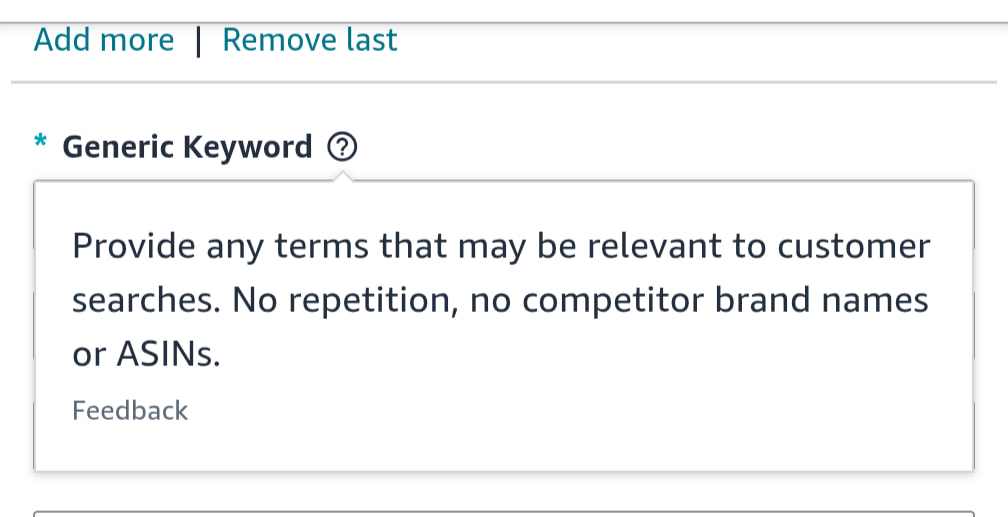
Looking for guidance on this section here. In videos I’ve watched for SEO there is one section for generic keyword. The current layout has five separate text boxes.
Guidance I’ve read says keep it under 249 Bytes.
Is that 249 total across all five or each of the five permits 249 Bytes?
It also says no repetition. How strict is that and what actually happens if there is repetition?
For example the word “patch” is repeated several times as the word in front of it has variation.
To add to that 1 comment above which answered your question, in the backend you put just relevant words and amazon will match them to customerss search terms. Make sure your listing is fully SEO optimised with main keywords in the title, bullet points, description etc.
For backend search terms, the 249-byte limit applies to the entire generic keywords section combined, not 249 bytes per box, because Amazon treats all five fields as one long string once you save them.
You should aim to keep the total under that limit, otherwise Amazon will ignore anything beyond the cutoff.
As for repetition, Amazon isn’t super strict in the sense that it won’t penalize you, but repeating words doesn’t help your ranking and only wastes valuable space because Amazon indexes each unique term only once. If “patch” appears multiple times in slightly different keyword phrases, you only need it once — Amazon automatically mixes and matches the words in any order.
If you repeat it a few times by accident, nothing bad happens, you just lose room for other potentially useful keywords. The best approach is to include each important word once, avoid commas, avoid brand names, and focus on adding as many unique relevant terms as possible within the byte limit.
Most Amazon sellers make the mistake of using the same rule for every keyword. For example, they think that if a keyword gets 10 clicks and no sale, the bid should be lowered immediately. But not all keywords serve the same purpose. Some are strong performers that need protection and budget, while others are still being tested to discover new opportunities.
Another common mistake is focusing only on lowering ACOS. ACOS is important, but reducing bids too aggressively can hurt visibility, and when visibility drops, total sales often drop as well. Lower ACOS does not always mean higher profit.
A better approach is to group keywords by performance. You should know which keywords are your top sellers, which ones are wasting spend, and which ones are still in the testing stage. It is also important to remember that match types behave differently. Broad match usually needs more clicks before converting, while exact match is more targeted and often converts faster.
Instead of relying on fixed rules, use your account’s overall performance as a guide. In many accounts, a small percentage of keywords generate most of the sales. Those are the keywords that need the most attention and protection.
To manage PPC better, review your bulk files and search term reports regularly, ideally using the last 14 days of data. Identify your best-performing keywords, calculate how many clicks different match types usually need before a sale, and label keywords clearly based on performance. When making bid changes, avoid drastic cuts. Small adjustments of 2% to 5% are usually much safer and help keep performance stable.
The main lesson is simple, not every keyword should be treated the same, and not every high-ACOS keyword should be cut immediately. Sometimes patience, structure, and smarter decision-making lead to better results than reacting too quickly.