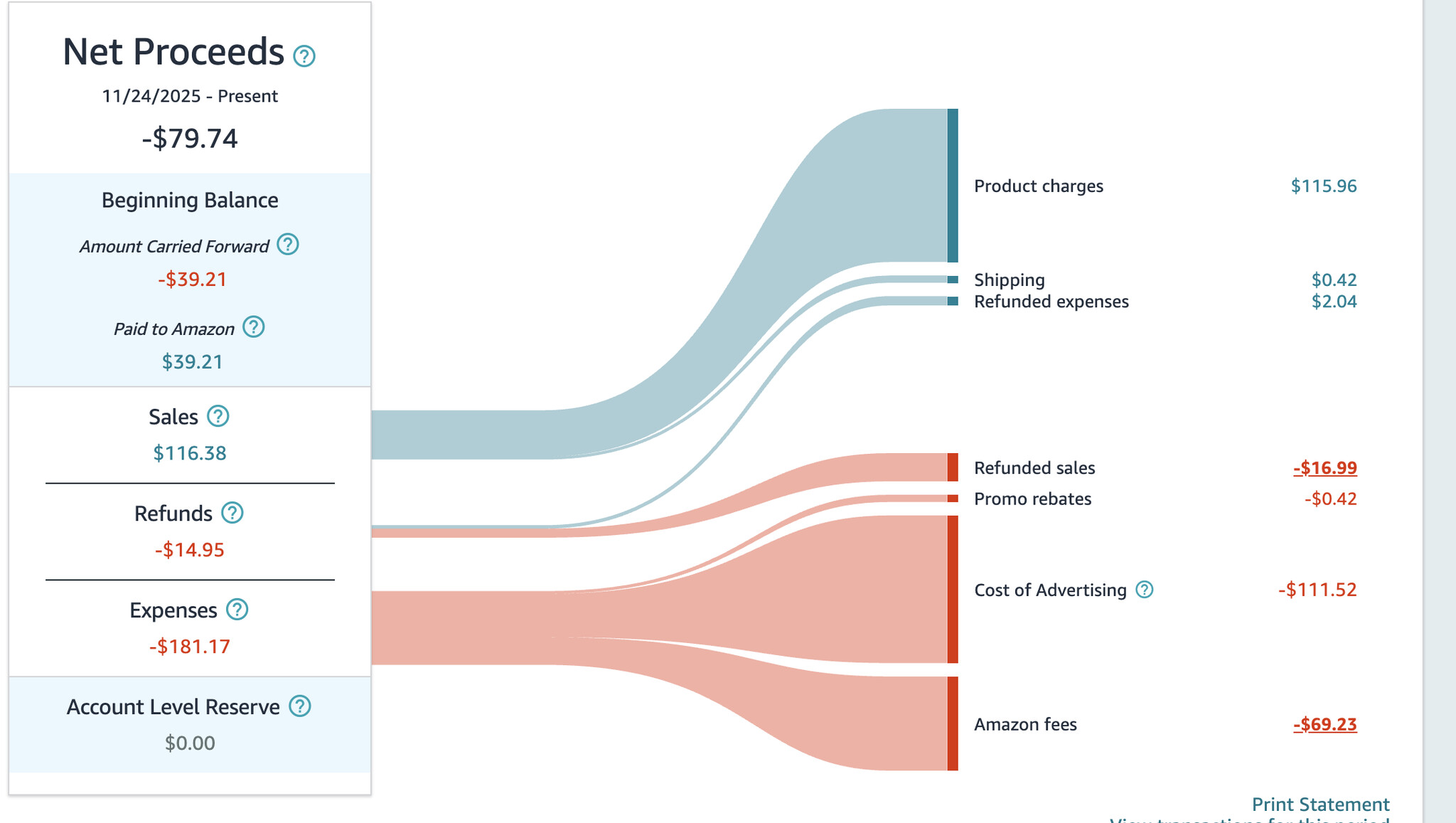
You are spending $111.52 for generating sales worth $116.38. Your ads are not converting.
Ads take too much of your profits, you need to either take the cost of ads down or increase prices to increase margin.
Most Amazon sellers waste money on PPC because they don’t track performance properly.
They run broad campaigns, never optimize keywords, and forget to cut off wasted spend. From my experience, a good PPC strategy is not about spending more, it’s about spending smart. I always focus on keyword match types, bid adjustments, and regular optimization to improve ACOS.
The reality is that if you don’t manage ads carefully, you’re just feeding Amazon, not building profit. Contract me for proven Amazon strategies.
Factors are the wrong pricing, your ads are not converting well. If you can check your organic and ads compare it then analyze which is better then focus on optimizing your listing and pricing strategy.
You might be looking at the right metrics…
but interpreting them with the wrong math.
This is where sellers slip up:
→ ACoS looks strangely low (or way too high)
→ CPC seems cheap (or suddenly expensive)
Here’s the real issue:
→ ACoS and CPC are averages, not totals
→ When you add them across products or campaigns, the numbers become misleading
And that leads to dangerous decisions:
→ You assume a campaign is profitable when it’s actually bleeding
→ You turn off a search term that’s quietly driving conversions
The lesson?
Always check how your metrics are calculated, especially when you’re working with exports, bulk reports, or any aggregated dashboard.
Accurate data isn’t enough.
You have to interpret it correctly.
When was the last time you verified the math behind your ACoS or CPC?
Factors are the wrong pricing, your ads are not converting well. If you can check your organic and ads compare it then analyze which is better then focus on optimizing your listing and pricing strategy.
A lot of sellers only look at referral fees and FBA fulfillment fees, but the hidden fees are often what make the real difference in profitability. It is very important to check for charges such as long-term storage fees, removal or disposal fees, inventory placement fees, high-volume listing fees, and refund administration fees, because these can quietly reduce your margins every month. On paper, the product may still look profitable, but once these costs are included, the actual profit can be much lower. In QuickBooks, some of these fees may be better treated as cost of goods sold, while others should sit under operating expenses, so proper mapping really matters. If you use A2X, it can help separate them correctly, but only if the accounts are set up properly. My advice would be to review your Amazon fee reports regularly and make sure these charges are being tracked separately, otherwise your numbers can look much better than the reality.